

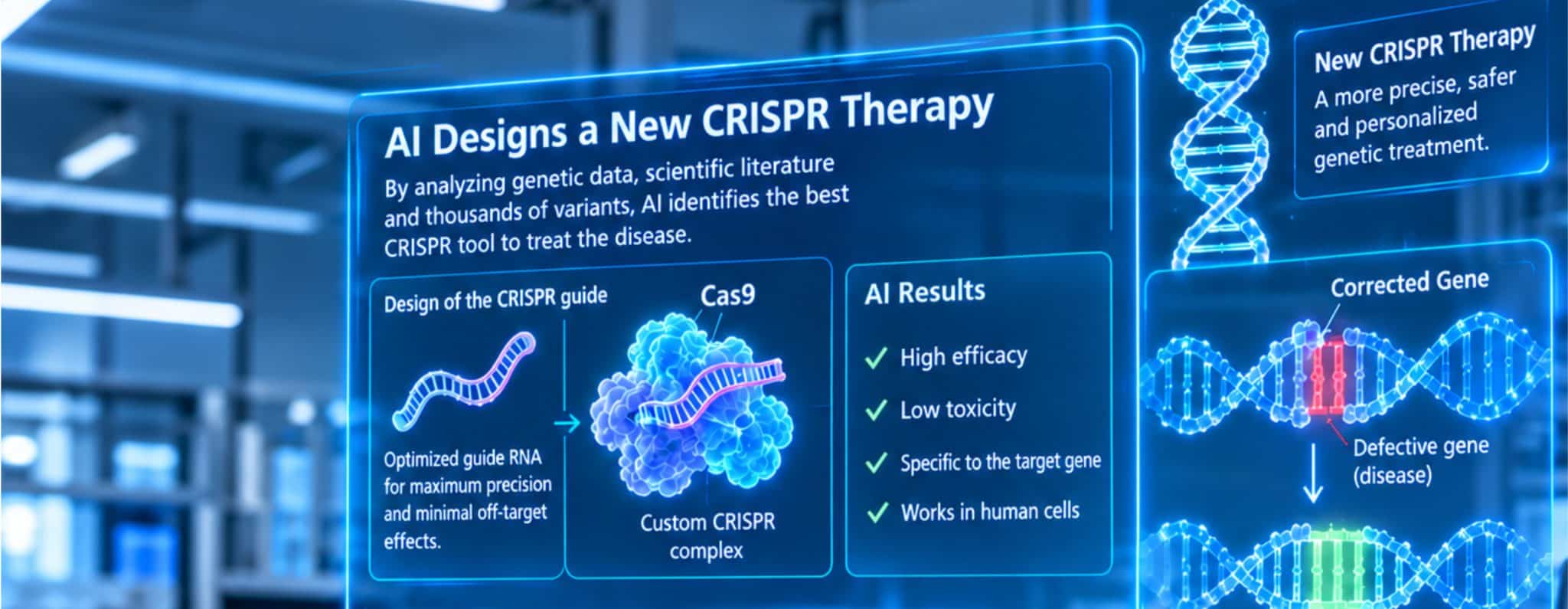
Artificial intelligence (AI) is opening up new possibilities in genetic research, but it also raises important bioethical questions regarding the limits of its role in science, the attribution of discoveries, and the need for caution when translating its findings into [...]

CRISPR technology, which has traditionally relied on guide RNA molecules to locate specific genetic sequences, may be entering a new era with the development of DNA-guided systems. This paradigm shift promises more stable, precise, and versatile gene editing tools, expanding [...]

CRISPR gene editing has evolved over the past decade from an experimental tool to a therapeutic platform with clinical trials in multiple areas: hematology, oncology, and rare, infectious, and metabolic diseases. In 2025, over 65 clinical trials evaluated CRISPR technologies or [...]

Faced with the urgent challenge of eradicating global hunger and finding sustainable alternatives to meat, the latest generation of genetic engineering offers a revolutionary solution. Using CRISPR-Cas9 technology, scientists have managed to optimize the fungus Fusarium venenatum by eliminating specific [...]

CRISPR-based gene therapy represents one of the most promising frontiers of precision medicine, especially in the treatment of mitochondrial diseases, hitherto considered incurable. This article by Nicolás Jouve analyses the latest scientific advances that have made it possible to overcome [...]

Since its inception in the 1980s, genetic engineering has evolved to become a high-precision tool in medicine. The advent of technologies such as CRISPR-Cas9 and its advancement towards systems such as prime editing and the recently developed bridge recombination has unlocked an unprecedented [...]

The major breakthroughs in genetic engineering took place in the 1960s and 1980s, and from these developments emerged the technologies that would allow the isolation, cloning and artificial transfer of genes from one individual to another, even between different species, [...]

Following approval in the United Kingdom and the United States, the European Medicines Agency (EMA) has recommended approval of CRISPR gene therapy for the treatment of beta thalassemia and sickle cell anemia in December 2023. Finally on February 12, 2024 the [...]

A woman with sickle cell anemia has been cured of this genetic disease through a therapy based on the CRISPR gene editing tool, as explained in a speech at the III International Summit on Human Genome Editing, held in London [...]

On January 13, the prestigious journal Science, of the American Association for the Advancement of Science, published an article by researchers from the Universities of Texas (U.S.A.) and Regensburg (Germany), led by Prof. Eric Olson, in which they described the [...]

CRISPR genome editing discoverers Jennifer Doudna and Emmanuelle Charpentier have won the Nobel Prize in Chemistry. Our Observatory has published many articles about gene-editing advances in biomedicine and their bioethical implications (read HERE). Since Emmanuelle Charpentier and Jennifer A. Doudna [...]

The CRISPR gene editing applications tool has opened up new possibilities of application in multiple areas of knowledge. Introduction Some of CRISPR gene editing applications raise serious ethical issues, such as the possibility of altering ecosystems (see HERE), or the use [...]


