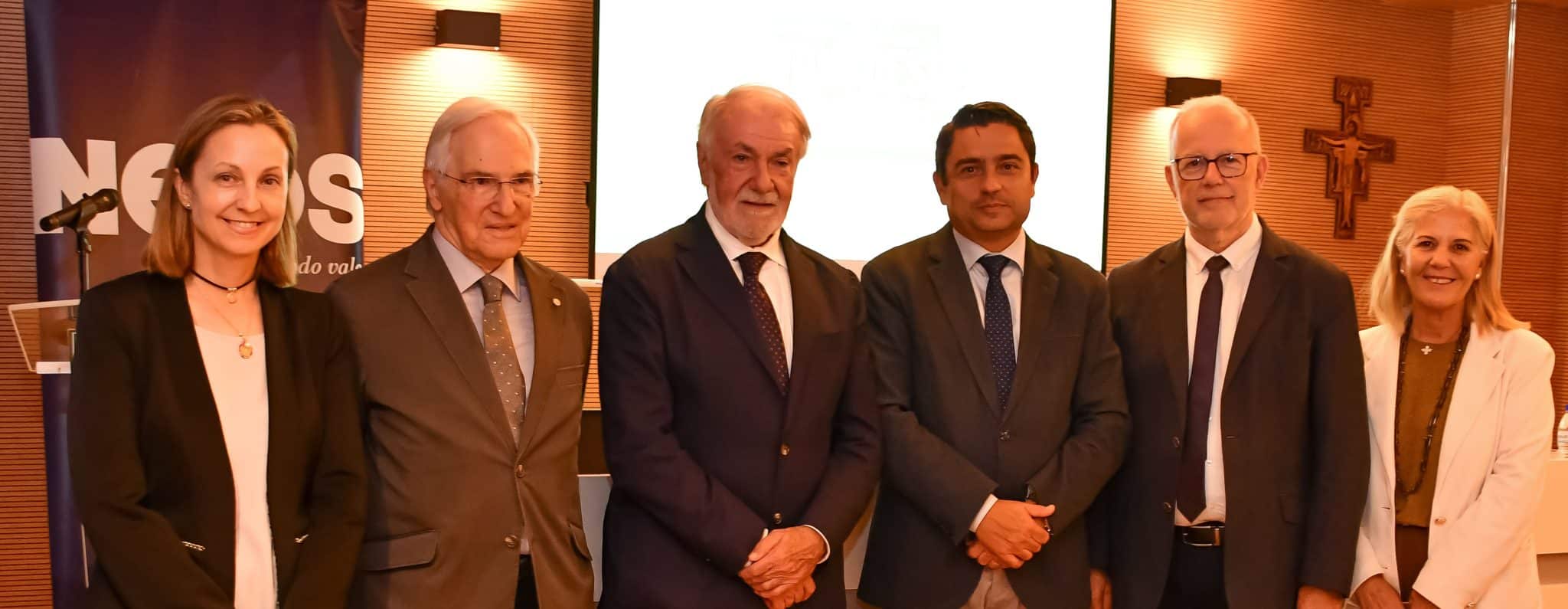
A member of the Bioethics Observatory of the Catholic University of Valencia has given a lecture at the European Parliament during the Week for Life sponsored by One of Us. The conference given by Dr. Enrique Burguete was about “Transhumanism and the emancipation of human nature. First signs” and took place in the session on “Transhumanism: responsibility in the age of robots”.

Transhumanism and transgender theory
He also warned that the transhumanist drift has its turning point in the gender perspective, which calls for the “self” to be redefined by emancipating the feeling of the sexed body itself and its functionality.
In this respect, he showed how the imminent Spanish gender legislation aspires to emancipate minors with respect to their natural essence, with respect to the scientific evidence and with respect to the protective role of the family.
Transhumanist drift has its turning point in the gender perspective, which calls for the “self” to be redefined by emancipating the feeling of the sexed body itself and its functionality.
Burguete finally urged the restoration of talks on the ends of nature, based on the biomedical sciences, philosophy and natural law, all from the deepest respect towards members of groups presumably safeguarded by the gender perspective, whose dignity was strongly underlined.
The above mentioned session on “Transhumanism: responsibility in the time of robots” was chaired by MEP Miroslav Mikolasik and his colleagues Marijana Petir, Alojz Peterle, Tunne Kelam, György Hölvenyi, Pavel Svoboda, Andrzej Grzyb, Peter Liese and other members of the European Parliament, and was also attended by representatives from member institutions of One of Us and the general public.
European One of Us Federation Ordinary General Assembly

The Bioethics Observatory applied to join the association, and through Carmen Mateu, professor at the University, presented the research lines currently being followed, such as CRISPR gene editing, transhumanism, end-of-life and gender ideology, highlighting particularly her work in bioethical aspects of the beginning of life. She also announced a new line of st
One of Us
The European citizens’ initiative One of Us was launched by a group of citizens from countries in the European Union to demand that community institutions guarantee the protection of human beings from conception in the areas of competence of the European Union.
This initiative brings together almost all pro-life and pro-family organisations within Europe, and has been the most successful initiative to date in terms of number of signatures collected (2 million) and number of countries involved.
The European Federation is made up of 25 European associations, combining strengths with the clear aim of fighting for the defence of all human life.